

When Success Feels Unsafe: Understanding Self-Sabotage
You might recognise this pattern:
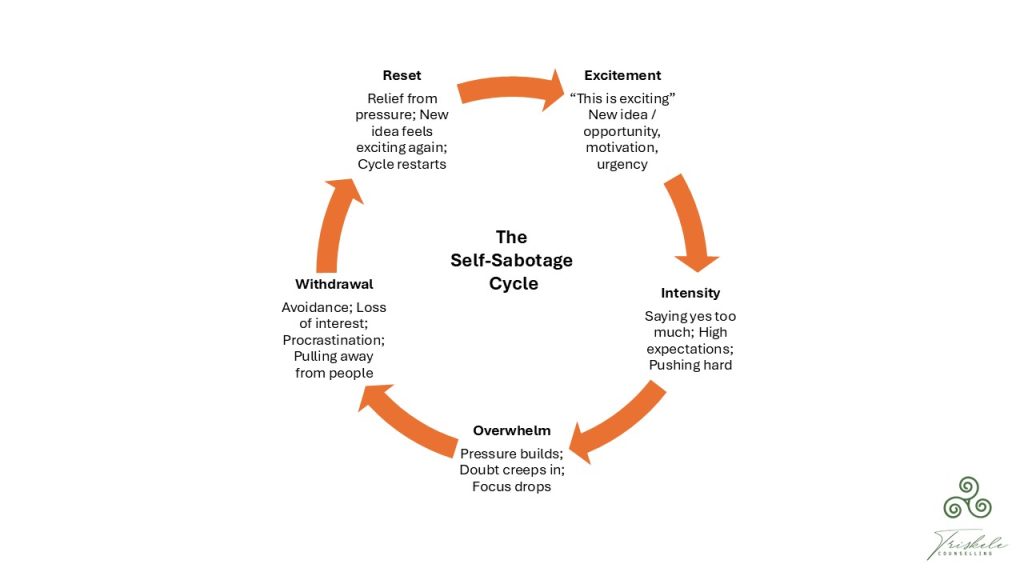
- You start something with energy.
- An idea, a project, an opportunity. It feels exciting. Full of possibility.
- But somewhere along the way… something shifts. You lose momentum. You disengage. Or things begin to unravel — sometimes even relationships connected to it.
And afterwards, you’re left wondering: “Why do I keep doing this?”
It Doesn’t Look Like Self-Sabotage at First
Self-sabotage doesn’t always look like avoidance. Sometimes it looks like:
- Starting multiple projects
- Investing time, energy, even money
- Feeling driven, motivated, even passionate
But struggling to follow things through. Every time you start the cycle it is genuinely meaningful — a vision of who you could become. A specialist. Someone skilled, recognised. But the pattern is really just a repeat. You start again… then stall. Another project then takes its place.
And when a real opportunity came — one that mattered, tied to someone else and something bigger — everything changed.
You lost interest.
The relationship broke down. And you were left not only with an unfinished project, but a difficult emotional aftermath.
This Isn’t Laziness. It’s Your Nervous System
What looks like self-sabotage is often your nervous system trying to protect you.
The beginning of something new brings:
- Energy
- Dopamine
- Possibility
It sits comfortably within your window of tolerance — a space where things feel manageable and even exciting. But as things progress, something changes.
Completion can bring:
- Visibility (“What if I’m judged?”)
- Pressure (“What if I can’t sustain this?”)
- Vulnerability (“What if this changes how others see me?”)
For some people, this pushes the nervous system into a threat response. Not danger in a logical sense — but something that feels unsafe on a deeper level.
Why the Middle and End Feel So Difficult
If you grew up in an environment where:
- Success led to pressure or criticism
- Being seen felt unsafe
- Expectations felt overwhelming
Then your system may have learned something important:
It’s safer to begin… than to arrive.
So instead of moving toward completion, your system redirects you.
Toward:
- A new idea
- A different project
- A fresh start
Because beginnings feel safe.
Endings feel exposing.
The Hidden Cost of This Pattern
Over time, this doesn’t just affect outcomes — it affects how you see yourself. You might start to believe:
- “I never finish anything.”
- “I lose interest too quickly.”
- “I mess things up.”
But these are not fixed traits. They are patterns shaped by protection.
How Therapy Can Help You Break the Cycle
Working with self-sabotage isn’t about forcing discipline. It’s about understanding what’s happening underneath. In therapy, we might explore:
- What happens in you as things become more real
- The point where your energy drops or shifts
- The emotional or relational meaning of success
From there, change becomes possible. Not by pushing harder — but by building capacity.
A Different Way Forward
Instead of asking:
“Why do I keep sabotaging this?”
You might begin to ask:
“What happens in me when I get closer to finishing?”
Because that moment — where things begin to feel uncomfortable — is not failure.
It’s information. And learning to stay there, just a little longer each time, can gently reshape the pattern.
You’re Not Broken
This isn’t about a lack of motivation.
It’s about a nervous system that learned, at some point:
That it’s safer to circle success than to fully step into it.
With the right support, that can change.
Looking for Support in Bedfordshire or Online?
I offer counselling for adults who feel stuck in patterns like this — whether that shows up in work, relationships, or a sense of not reaching your potential.
Together, we can explore what’s underneath these patterns and help you move forward in a way that feels safe, grounded and sustainable.
👉 Book a free 20-minute introductory call to see if we’re a good fit.